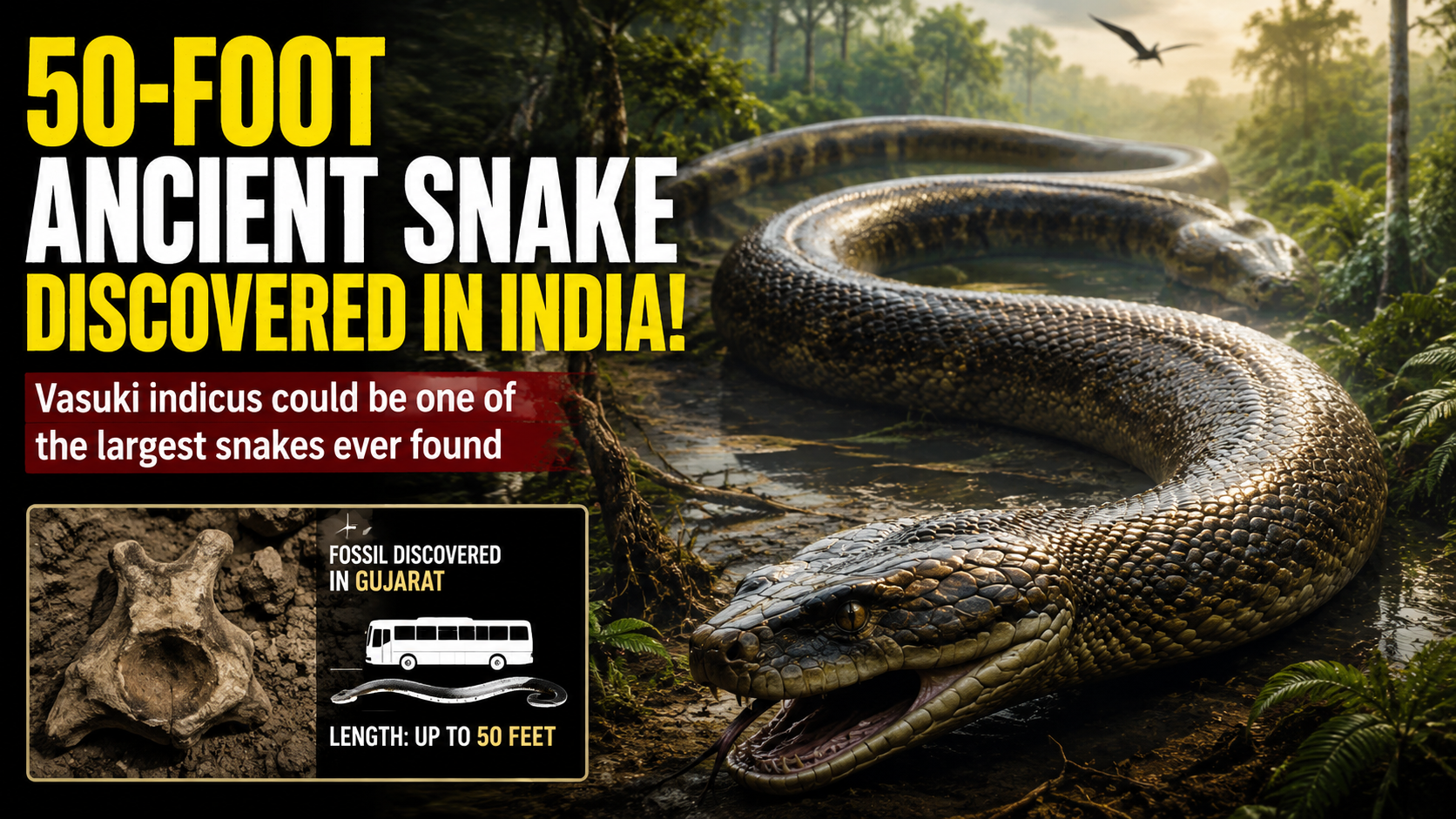
Imagine coming face-to-face with a snake as long as a city bus. Sounds like something straight out of mythology or a Hollywood monster film, right? But scientists believe such a creature may have actually existed millions of years ago in India.
A fascinating fossil discovery in Gujarat has revealed evidence of an enormous prehistoric snake named Vasuki indicus, which researchers say may have stretched nearly 50 feet long, making it one of the biggest snakes ever discovered on Earth.
The ancient serpent, named after the mythical snake Vasuki from Hindu mythology, lived around 47 million years ago and could potentially rival Titanoboa, the legendary giant snake considered one of the largest reptiles in history.
The discovery has generated excitement among scientists and history lovers alike, not just because of the snake’s jaw-dropping size, but also because it offers new insights into prehistoric life in India and the evolution of giant reptiles.
So, what exactly is Vasuki indicus, how big was it, and why are scientists calling it one of the most extraordinary fossil discoveries in recent years?
Let’s break it down.
What Is Vasuki Indicus?
Vasuki indicus is an extinct species of giant prehistoric snake discovered through fossil evidence in India.
According to a report published in Scientific Reports, scientists identified the species after analysing fossilised vertebrae found in the Panandhro Lignite Mine in Kutch, Gujarat.
Researchers believe the snake lived during the Middle Eocene period, roughly 47 million years ago.
The species was named:
- Vasuki — after the serpent king in Hindu mythology
- Indicus — referring to India, where it was discovered
The naming reflects both scientific significance and cultural symbolism.
How Scientists Discovered the Giant Snake
The Discovery in Gujarat
The fossil discovery was led by researchers Debajit Datta and Sunil Bajpai, who studied a collection of 27 fossilised vertebrae recovered from the mine.
What makes the discovery particularly exciting is that:
- Some bones were still connected
- Vertebrae remained relatively well-preserved
- Size estimates became more accurate
The fossil pieces helped researchers estimate the snake’s possible body length and physical structure.
Just How Big Was Vasuki Indicus?
A 50-Foot Prehistoric Giant
This is where things become truly mind-blowing.
Scientists estimate that Vasuki indicus may have measured somewhere between:
36 feet to nearly 50 feet long
That means:
- Longer than a city bus
- Nearly double modern giant snakes
- Comparable to Titanoboa
Some vertebrae reportedly measured more than 4 inches wide, indicating an incredibly thick and muscular body.
Experts estimate the snake could have weighed close to:
One tonne
Yes — a snake potentially weighing as much as a small vehicle.
Could Vasuki Indicus Be Bigger Than Titanoboa?
The Ultimate Giant Snake Debate
Whenever scientists talk about giant prehistoric snakes, one name immediately dominates the conversation:
Titanoboa
Titanoboa is widely considered one of the largest snakes ever discovered, estimated at around:
40–45 feet long
Now, Vasuki indicus may rival or even slightly exceed those estimates.
However, scientists remain cautious.
Since researchers currently have:
- Vertebrae fossils only
- No complete skeleton
they cannot definitively confirm the snake’s maximum size.
Still, fossil analysis strongly suggests Vasuki belongs among the largest snakes ever known.
How Did Vasuki Indicus Hunt?
Probably an Ambush Predator
Despite its monstrous size, scientists do not believe Vasuki indicus was particularly fast.
Instead, experts think it behaved similarly to modern:
- Anacondas
- Large pythons
The snake likely relied on:
Ambush Hunting
This means it probably:
- Waited silently for prey
- Used stealth instead of speed
- Overpowered victims using immense body strength
Its hunting style may have resembled giant constrictors seen today.
Researchers believe the prehistoric environment of India would have supported such enormous predators due to warm climate conditions and abundant prey.
How Big Are Today’s Largest Snakes?
To understand how shocking this discovery is, let’s compare Vasuki indicus with modern snakes.
| Snake Species | Estimated Length |
|---|---|
| Reticulated Python | 25–30 feet |
| Green Anaconda | 20–30 feet |
| Titanoboa | Around 40 feet |
| Vasuki indicus | Up to nearly 50 feet |
In simple words:
Vasuki indicus may have been almost twice the size of today’s largest snakes.
That’s prehistoric monster territory.
The Madtsoiidae Family Explained
Vasuki’s Ancient Snake Family
Scientists believe Vasuki indicus belonged to an ancient snake family called:
Madtsoiidae
This extinct snake lineage survived for nearly:
100 million years
The family spread across regions including:
- India
- Africa
- Europe
- South America
Researchers believe India may have played an important role in the evolution of giant snakes from this family.
Some experts suspect large madtsoiids first evolved in India before spreading globally during the Eocene era.
Why This Discovery Matters
More Than Just a Giant Snake
The excitement around Vasuki indicus isn’t only about size.
Scientists say the discovery helps answer important questions about:
- Ancient ecosystems
- Evolution of giant reptiles
- Climate history
- Predator-prey relationships
- Geological evolution of India
The fossil also highlights India’s growing importance in paleontology.
Many prehistoric discoveries from the country are reshaping what scientists know about ancient life.
Why Was India the Perfect Place for Giant Snakes?
Warm Climate Played a Big Role
Scientists believe prehistoric India had:
- Warmer temperatures
- Dense wetlands
- Rich biodiversity
- Suitable prey populations
Large cold-blooded animals generally thrive in warm climates because heat supports metabolism and growth.
This may explain how snakes like Vasuki indicus reached unimaginable sizes.
The same theory has been used to explain Titanoboa’s gigantic body.
Social Media Reacts to the Discovery
The internet quickly became fascinated by the idea of a 50-foot snake living in India millions of years ago.
Users reacted with comments like:
- “This sounds terrifying!”
- “Straight out of mythology.”
- “India really discovered a monster snake?”
- “Titanoboa finally has competition!”
Many people also loved the connection between the fossil and Hindu mythology through the name Vasuki.
Key Highlights
- Scientists discovered Vasuki indicus fossils in Gujarat, India
- The snake lived around 47 million years ago
- Estimated length: up to nearly 50 feet
- Could rival Titanoboa as one of the biggest snakes ever
- Fossils include 27 vertebrae found in Kutch
- Belonged to the ancient Madtsoiidae snake family
- Likely hunted through ambush rather than speed
Expert Analysis
Paleontologists believe Vasuki indicus could become one of India’s most important prehistoric discoveries.
Experts note that:
- Fossil evidence appears highly significant
- India may have played a larger role in giant snake evolution than previously believed
- More excavation could reveal additional skeleton parts
- Future research may refine size estimates further
Some scientists believe the discovery could rewrite parts of snake evolutionary history.
FAQ SECTION
What is Vasuki indicus?
Vasuki indicus is an extinct prehistoric snake species discovered through fossils in Gujarat, India.
How big was Vasuki indicus?
Scientists estimate it may have grown between 36 and nearly 50 feet long.
Where was Vasuki indicus discovered?
Its fossils were found in the Panandhro Lignite Mine in Kutch, Gujarat.
Could Vasuki indicus be bigger than Titanoboa?
Possibly. Scientists believe it rivals Titanoboa in size, though more fossil evidence is needed.
Why is the snake named Vasuki?
It was named after Vasuki, the serpent king from Hindu mythology.
CONCLUSION
The discovery of Vasuki indicus is the kind of scientific story that instantly captures the imagination. A prehistoric snake stretching nearly 50 feet across ancient India feels almost impossible to believe — yet fossil evidence suggests such a creature may have truly existed.
Whether or not Vasuki eventually overtakes Titanoboa as the biggest snake ever discovered, one thing is already clear: India’s prehistoric past was far more extraordinary than many imagined.
As scientists continue researching the fossil remains, this giant serpent may reveal even more secrets about Earth’s ancient ecosystems and the terrifying giants that once ruled them.
For more trending science, entertainment, and viral stories, stay tuned to FilmyGags.com.