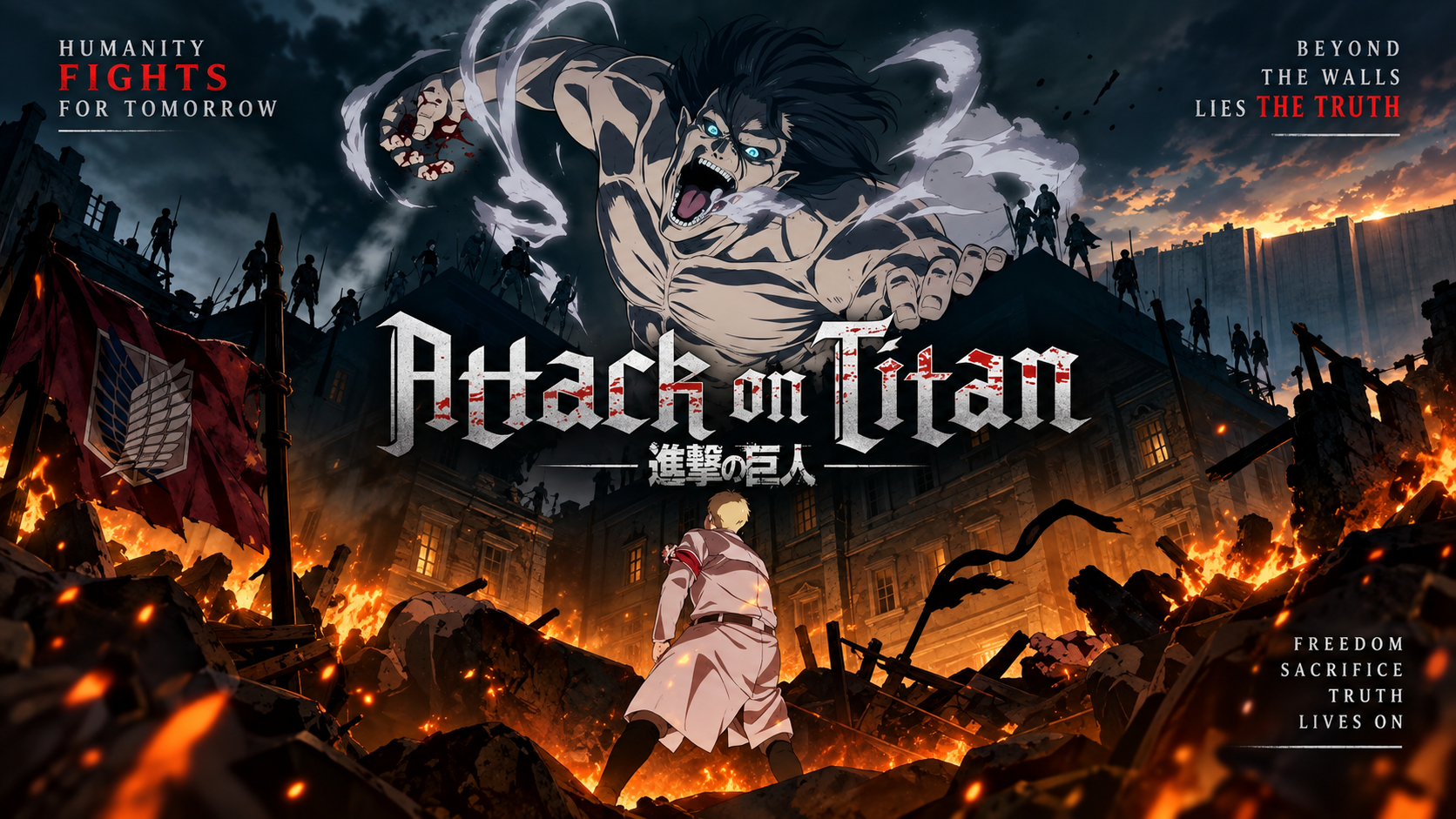
Attack on Titan anime, also known as Shingeki no Kyojin, is one of the most influential anime series of the modern era. What begins as a seemingly straightforward story about humans fighting giant creatures eventually develops into a much larger narrative involving war, politics, history, identity, freedom and the consequences of revenge.
The series is based on the manga created by Hajime Isayama and became widely known for its intense action, dramatic character development and unexpected story revelations.
At the centre of the story is Eren Yeager, a young boy who dreams of seeing the world beyond the enormous walls surrounding his home. Alongside his childhood friends Mikasa Ackerman and Armin Arlert, Eren grows up in a society where humanity’s survival depends on keeping the Titans outside.
But the apparent simplicity of that world does not last.
The story gradually reveals that the truth about the Titans, the walls and the world outside is much more complicated than the characters initially understand.
This article explores the Attack on Titan anime, its story, major characters, Titan powers, important arcs, themes and the reasons it continues to attract anime fans around the world.
What Is Attack on Titan?
Attack on Titan is a dark fantasy and action anime that combines elements of military fiction, mystery, horror and political drama.
The story is set in a world where humanity has been pushed to the brink of extinction by gigantic humanoid creatures known as Titans.
To protect themselves, people live inside enormous defensive walls.
For generations, many residents believe that the walls are the last remaining safe place for humanity.
The military is divided into different branches, each serving a specific purpose.
Some soldiers defend the walls directly, while others operate inside the cities or venture beyond the walls to investigate the outside world.
The conflict between humanity and the Titans forms the initial foundation of the anime.
As the story progresses, however, the scale of the conflict expands dramatically.
Eren Yeager
Eren Yeager is the central protagonist of Attack on Titan.
From childhood, Eren is fascinated by the world outside the walls.
He feels trapped by the limitations placed on humanity and dreams of seeing landscapes beyond the boundaries of his home.
His personality is passionate, determined and sometimes reckless.
After a devastating Titan attack changes his life, Eren decides to join the military and dedicate himself to fighting the creatures responsible.
Eren’s character undergoes one of the most dramatic transformations in the series.
As he learns more about the world, his beliefs change.
The simple distinction between heroes and enemies becomes increasingly difficult to maintain.
His pursuit of freedom eventually becomes connected to some of the biggest conflicts in the entire story.
Mikasa Ackerman
Mikasa Ackerman is one of the strongest soldiers in the series and one of Eren’s closest companions.
She is highly skilled, disciplined and exceptionally capable in combat.
Mikasa’s relationship with Eren is central to her character, but she is much more than simply a supporting figure.
Her abilities make her an essential member of the military, while her personal history contributes to the emotional complexity of the story.
Mikasa often acts as a protective force for Eren and Armin, particularly during the early stages of their journey.
Her character also raises questions about loyalty, family and the choices people make when protecting those they love.
Armin Arlert
Armin Arlert represents another important strength within the main trio.
Unlike Eren and Mikasa, Armin is not initially defined by physical power.
Instead, he is intelligent, analytical and capable of understanding situations from unusual perspectives.
His strategic thinking repeatedly helps the group survive situations where physical strength alone would not be enough.
Armin’s development is particularly significant because he gradually becomes more confident in his ability to make difficult decisions.
His journey demonstrates that courage is not always about fighting.
Sometimes, courage means accepting responsibility when the consequences are frightening.
The Titans
Titans are the defining creatures of Attack on Titan.
At first, they appear to be simple monsters that exist only to eat humans.
They vary greatly in size and appearance, creating some of the anime’s most unsettling visual moments.
Ordinary Titans can behave unpredictably, which makes them dangerous even when their actions seem primitive.
However, the story eventually reveals that Titan biology and history are far more complicated.
The discovery of intelligent Titans fundamentally changes the nature of the conflict.
Suddenly, humans are no longer simply fighting mindless monsters.
There are individuals capable of transforming into Titans and controlling their abilities.
The Nine Titans
One of the most important discoveries in the series is the existence of the Nine Titans.
These special Titan powers possess unique abilities and can be inherited by different people.
Important examples include:
Attack Titan
The Attack Titan is associated with Eren and plays a major role in the central story.
Its abilities and history become closely connected to the larger mystery surrounding Eldia, Marley and the Titan world.
Founding Titan
The Founding Titan possesses extraordinary abilities related to the Subjects of Ymir and the broader Titan system.
Its power becomes central to the final stages of the story.
Colossal Titan
The Colossal Titan is enormous and capable of producing tremendous destructive force.
Its size makes it one of the most visually intimidating Titans in the anime.
Armored Titan
The Armored Titan possesses heavily protected skin, allowing it to withstand many attacks.
Its combat abilities make it a major military threat.
Female Titan
The Female Titan combines mobility, combat ability and several unusual Titan characteristics.
Its identity becomes one of the early major mysteries of the series.
Beast Titan
The Beast Titan is particularly distinctive because of its animal-like appearance and unique abilities.
Its role becomes increasingly important as the story expands beyond the original conflict.
The Walls
The walls are one of the most important symbols in Attack on Titan.
At the beginning of the story, they represent safety.
People believe that the enormous structures protect them from Titans and provide the last refuge of civilisation.
But the walls also represent confinement.
Eren’s desire to see the outside world is partly a desire to escape that confinement.
As viewers learn more about the origins of the walls, their meaning changes.
They are no longer simply physical barriers.
They become symbols of history, fear, political control and humanity’s attempt to protect itself from a larger world.
The Survey Corps
The Survey Corps is one of the most important military branches in the series.
Its soldiers venture beyond the walls to gather information about the Titans and the world outside.
Because these missions are extremely dangerous, Survey Corps members often face enormous risks.
The organisation becomes home to many of the series’ most memorable characters.
Their distinctive uniforms, equipment and military culture have also become iconic parts of Attack on Titan.
The Survey Corps represents humanity’s willingness to seek answers even when the truth may be dangerous.
Levi Ackerman
Captain Levi is one of the most popular characters in Attack on Titan.
Known for his exceptional combat skills, Levi is calm, disciplined and highly observant.
He is widely regarded as one of humanity’s strongest soldiers.
But Levi’s appeal comes from more than his fighting ability.
He is a character shaped by loss, responsibility and difficult decisions.
He understands that military victories often come with sacrifices.
His relationship with other members of the Survey Corps adds emotional depth to his character.
Erwin Smith
Erwin Smith serves as one of the most important leaders in the Survey Corps.
He is intelligent, strategic and willing to make extremely difficult decisions.
Erwin’s primary goal is to uncover the truth behind the world surrounding the walls.
His leadership often requires him to send soldiers into situations where survival is uncertain.
This makes his character closely connected to one of the central themes of Attack on Titan: how much should people sacrifice in pursuit of truth?
The Mystery of the Basement
One of the longest-running mysteries in the anime is connected to Eren’s family home and the basement.
Early in the story, Eren’s father leaves behind a secret related to what lies inside.
For a significant portion of the series, the characters work toward reaching that basement.
The eventual revelation becomes one of the most important turning points in Attack on Titan.
It dramatically expands the story beyond the walls and changes the audience’s understanding of the world.
Marley and the Outside World
One of the biggest transformations in Attack on Titan occurs when the story expands beyond the walls.
The characters discover that humanity has not disappeared from the rest of the world.
Instead, there are other nations, political systems and societies with their own history and perspectives.
Marley becomes a central power in the story.
This revelation changes the conflict from a survival battle between humans and Titans into a much larger geopolitical struggle.
The series begins exploring themes of nationalism, inherited hatred, propaganda and historical memory.
Attack on Titan’s Themes
One of the reasons the anime became so popular is its willingness to explore serious themes.
Freedom
Freedom is perhaps the most important idea in the series.
Eren’s desire to reach the outside world begins as a simple childhood dream.
Over time, the meaning of freedom becomes far more complicated.
What does it mean to be free?
Can a person be free while carrying the consequences of past generations?
Can freedom exist when another group believes your existence threatens theirs?
The anime never treats these questions as simple.
War
War is another major theme.
Attack on Titan shows that military conflict is not simply about winning.
There are civilians, soldiers, families and future generations affected by every decision.
The series repeatedly demonstrates how violence creates consequences that can continue long after one battle ends.
Revenge
Characters throughout the story are motivated by loss and anger.
But revenge creates new suffering.
Attack on Titan explores how cycles of violence can continue when every side believes it is responding to something that happened in the past.
Identity
Characters are constantly forced to reconsider who they are.
Eren’s identity changes.
Other characters discover hidden family histories.
Groups of people are defined by labels imposed on them by society.
The question of identity therefore becomes closely connected to history and politics.
The Animation and Action
The anime became known for its dramatic action sequences.
The use of vertical movement, rapid camera transitions and detailed backgrounds created a strong visual identity.
The Omni-Directional Mobility Gear allows soldiers to move through cities and forests at high speed, creating dynamic combat sequences.
Titan battles are also visually distinctive because of their scale.
The contrast between tiny human soldiers and enormous Titans creates a strong sense of danger.
The Music of Attack on Titan
Music plays a major role in the anime’s emotional impact.
The soundtrack combines orchestral elements, dramatic vocals and powerful themes to create an atmosphere that can shift quickly between tension and tragedy.
Opening and ending themes also became major parts of anime culture, with fans discussing the music alongside the story itself.
The combination of visuals and music helped turn many major moments into unforgettable sequences.
Why Attack on Titan Became So Popular
Several factors contributed to the series’ worldwide popularity.
The first is its mystery.
The story constantly asks questions and encourages viewers to look for answers.
The second is its character development.
Characters change significantly over time.
The third is the world-building.
The story gradually expands from one enclosed society to a much larger geopolitical world.
The fourth is its willingness to take risks.
Major characters can die.
Unexpected alliances can form.
Previously understood facts can turn out to be incomplete or misleading.
This unpredictability helped keep audiences engaged.
Attack on Titan and the Anime Community
The series became a major part of global anime culture.
Fans created theories, artwork, cosplay, memes, videos and discussions about nearly every major revelation.
Because the story contained so many mysteries, online communities became places where viewers debated possible explanations.
The anime therefore became more than something people watched.
It became something people analysed together.
Is Attack on Titan Suitable for Everyone?
Attack on Titan contains intense violence, death, frightening imagery and mature themes.
The story also deals with war, discrimination, political conflict and psychological trauma.
It is generally better suited to viewers who are comfortable with darker storytelling.
Parents should check age ratings and regional content guidance before allowing younger viewers to watch.
Final Thoughts
Attack on Titan is much more than a story about humans fighting giant monsters.
It begins with a simple question: how can humanity survive behind enormous walls?
But that question eventually becomes something much larger.
Who built the walls?
Why do Titans exist?
What lies beyond the sea?
Who is responsible for the conflict?
Can people escape the hatred created by previous generations?
And what does freedom really mean?
Through Eren, Mikasa, Armin, Levi, Erwin and countless other characters, Attack on Titan explores those questions through a combination of action, mystery and emotional storytelling.
Its Titans provide the spectacle.
Its mysteries provide the suspense.
Its characters provide the emotional connection.
And its larger themes give the story lasting impact.
For anime fans looking for a series that combines intense battles with complex world-building and serious themes, Attack on Titan remains one of the most distinctive modern anime experiences.
Frequently Asked Questions
What is Attack on Titan about?
Attack on Titan follows Eren Yeager and his friends as they fight Titans threatening humanity inside enormous protective walls. The story later expands into a much larger conflict involving other nations, history and the origins of the Titans.
Who are the main characters in Attack on Titan?
The central characters include Eren Yeager, Mikasa Ackerman and Armin Arlert. Other major characters include Levi Ackerman, Erwin Smith and numerous members of the Survey Corps.
What are Titans?
Titans are giant humanoid creatures that initially appear to threaten humanity. The story later reveals that some Titans have unique abilities and can be controlled by humans who possess special Titan powers.
What are the Nine Titans?
The Nine Titans are special Titan powers with distinct abilities. They include the Attack Titan, Founding Titan, Colossal Titan, Armored Titan, Female Titan and Beast Titan among others.
Is Attack on Titan a horror anime?
It contains horror elements, disturbing imagery and intense violence, but it also combines action, fantasy, science fiction, mystery and political drama.
Why is Attack on Titan so popular?
Its popularity is linked to its mystery, character development, complex world-building, emotional storytelling, intense action and willingness to challenge viewers’ expectations.
Is Attack on Titan suitable for children?
It contains significant violence, death and mature themes, so parents should check the appropriate age rating and content guidance before allowing younger viewers to watch.
Is Attack on Titan worth watching?
For viewers who enjoy dark fantasy, action, mystery, military stories and complex character development, Attack on Titan offers a highly layered viewing experience.
This website is proudly managed by Shunya Digit.