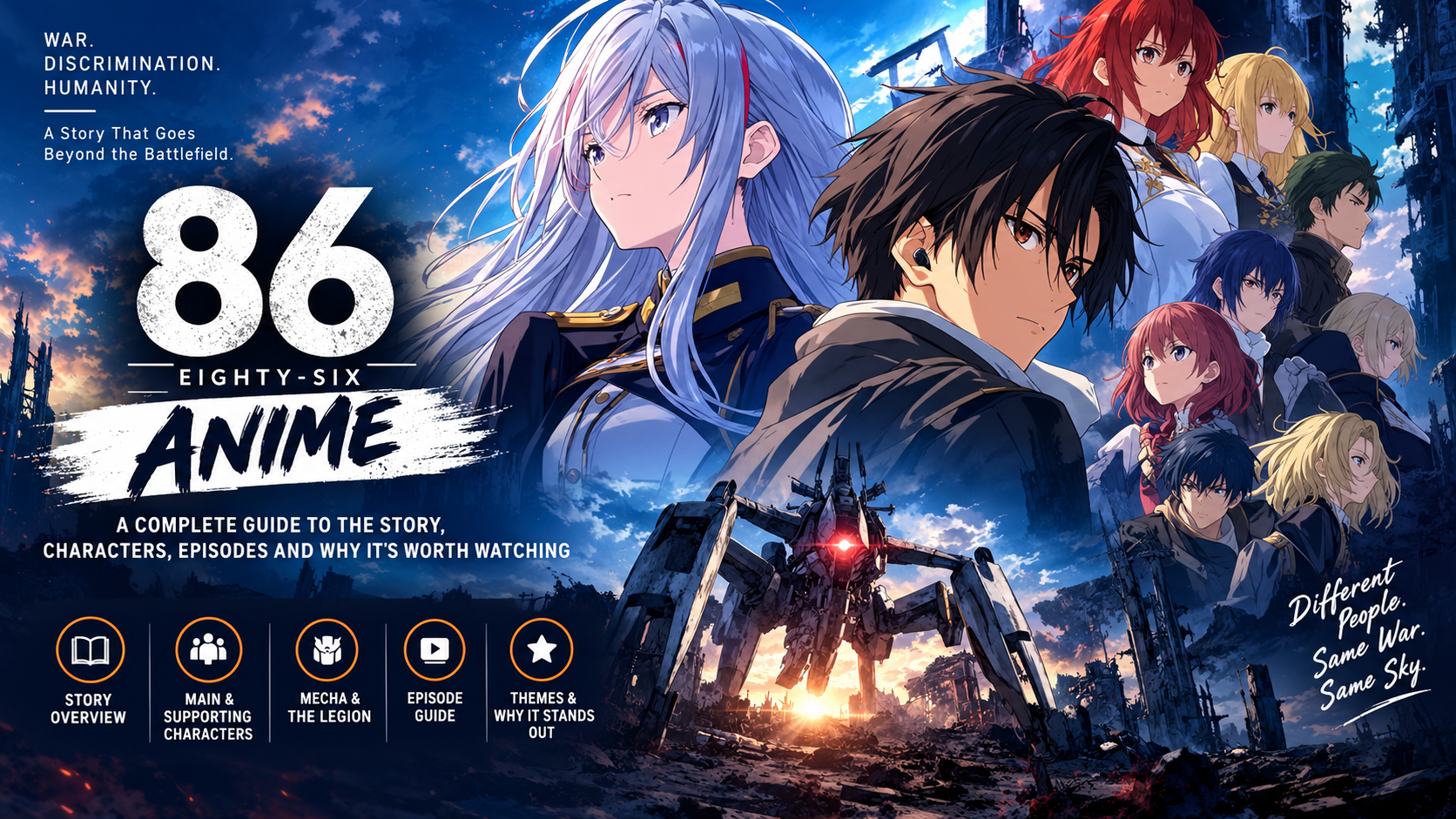
The 86 anime, commonly known as 86 -Eighty-Six-, is a science-fiction and military anime that combines intense battlefield action with emotional storytelling, political themes and memorable character development.
At first glance, 86 looks like a futuristic mecha series. There are advanced machines, military operations, battles and a technologically developed world. But the story is much more than a traditional robot anime.
At the centre of the series is a brutal social system in which one group of people is officially treated as if they are not even part of society. These people, known as the Eighty-Six, are forced to fight on the front lines while the privileged population watches the war from relative safety.
The result is a story about discrimination, war, identity, survival, grief and human connection.
The anime follows two characters from completely different sides of this divided society: Vladilena “Lena” Milizé, an officer trying to change the military system from within, and Shinei “Shin” Nouzen, a battlefield commander who leads the Eighty-Six through seemingly impossible missions.
Their relationship gives the story its emotional centre.
What Is the 86 Anime?
86 -Eighty-Six- is a science-fiction military anime adaptation based on the light novel series written by Asato Asato and illustrated by Shirabii.
The anime is set in the world of the Republic of San Magnolia, a nation involved in a war against the neighbouring Giadian Empire and its autonomous military forces.
The Republic publicly claims to have developed a system of unmanned weapons, creating the impression that its citizens are protected from direct combat.
The reality is much darker.
The machines being described as autonomous are operated and controlled through the forced involvement of the Eighty-Six.
The government separates these people from the rest of the population and treats them as expendable soldiers.
This contradiction between public propaganda and battlefield reality is one of the foundations of the series.
Why Is It Called 86?
The title refers to the Eighty-Six, the people who have been pushed outside the recognised social system of the Republic.
They are confined to an area known as the Eighty-Sixth Sector and sent to fight as frontline forces.
Officially, they are often described in ways that hide the reality of their situation.
The name therefore becomes more than a number.
It represents a system in which people are denied equal recognition while being expected to risk their lives for the same society that excludes them.
This makes the title itself an important part of the anime’s themes.
The Story of 86
The story begins in a divided society.
The Republic of San Magnolia presents itself as an advanced nation protected by a powerful military system.
Citizens living within the protected areas can believe that the war is being fought by machines.
But beyond this image exists a brutal reality.
The Eighty-Six are sent into combat against the enemy’s autonomous Legion forces.
Unlike the protected citizens, they experience the war directly.
They fight.
They lose friends.
They witness death.
They continue because stopping can mean immediate destruction.
Lena becomes increasingly aware that the official version of the war is built around a massive lie.
As she begins working with the Eighty-Six, she starts to understand what is really happening on the battlefield.
This leads to her connection with Shin and his unit.
Vladilena Milizé
Vladilena Milizé, usually called Lena, is one of the two central characters.
She is an officer in the Republic’s military and initially occupies a position that separates her from the Eighty-Six.
Unlike many other members of the privileged population, however, Lena is deeply disturbed by the treatment of the frontline soldiers.
She refuses to accept the idea that the Eighty-Six are disposable.
Lena’s character development is one of the most important parts of the anime.
At the beginning, she believes that she can use her position to improve the situation through military leadership and moral determination.
But reality quickly proves much more complicated.
She has to confront prejudice, bureaucracy and people who have become comfortable with the system.
Her growth comes from learning that caring about injustice is not the same as being able to solve it easily.
Shinei Nouzen
Shinei Nouzen, commonly called Shin, is the other central character.
He is a young battlefield commander among the Eighty-Six.
Shin is calm, highly capable and emotionally scarred by years of warfare.
One of his most distinctive abilities is his extraordinary awareness of the battlefield.
He has earned the reputation of being an exceptionally dangerous and effective fighter.
Yet his strength comes with an emotional cost.
Shin has experienced repeated loss, and the constant presence of death has changed how he views the world.
His role as a commander means that he does not simply fight for himself.
He also carries the burden of knowing that the people under his command may die.
This makes him one of the most complex characters in the series.
Shin and Lena’s Relationship
The connection between Shin and Lena is one of the strongest elements of 86.
They begin from completely different positions.
Lena is behind the protected system.
Shin is on the battlefield.
They communicate through technology rather than meeting face-to-face at first.
Their conversations slowly create trust.
Lena begins to understand what Shin and the other Eighty-Six experience.
Shin gradually realises that Lena is genuinely trying to treat them as human beings rather than military resources.
Their relationship is not built instantly.
It develops through communication, shared experiences and the gradual breaking down of the social barrier between them.
This makes their connection especially meaningful.
The Spearhead Squadron
The Spearhead Squadron is a central military unit within the story.
Shin serves as its leader, surrounded by other young fighters who have their own personalities, histories and relationships.
The members of the squadron are not simply background soldiers.
Their presence gives the audience a stronger understanding of what it means to live as an Eighty-Six soldier.
The group develops a sense of family despite the constant danger surrounding them.
This makes the losses within the squadron emotionally powerful.
Viewers are not watching anonymous soldiers disappear.
They are watching characters they have come to know.
The Other Important Characters
One of the strengths of 86 is its ensemble cast.
Characters such as Raiden Shuga, Anju Emma, Kurena Kukumila, Theo Rikka and others add different perspectives to the Eighty-Six experience.
Raiden Shuga
Raiden is one of Shin’s closest comrades.
He provides a grounded contrast to Shin’s more emotionally distant personality and has a strong sense of responsibility toward the squadron.
Anju Emma
Anju is intelligent, kind and emotionally complex.
Her past and experiences reveal how deeply discrimination affects the Eighty-Six beyond the battlefield itself.
Kurena Kukumila
Kurena is a skilled fighter whose personality combines determination with youthful emotion.
Her character helps show that the Eighty-Six are not simply soldiers; they are young people who have been denied the opportunity to live normal lives.
Theo Rikka
Theo is another important member of the squadron.
His artistic side and strong emotions make him distinctive, while his experiences contribute to the show’s exploration of identity and trauma.
The Legion
The Legion are the primary enemy forces in the series.
They are autonomous military machines originally created as weapons.
Their existence creates the central technological threat of the story.
However, the Legion are more than simple enemies.
As the story develops, the nature of their operation and intelligence becomes increasingly important.
The anime uses the Legion not only as battlefield opponents but also as a way to explore questions about technology, humanity and the consequences of war.
The Juggernaut
The Eighty-Six use specialised combat machines known as Juggernauts.
These machines are smaller and more agile than many conventional giant mecha designs.
Their appearance and battlefield role reinforce an important point about the Eighty-Six.
They are not presented as glamorous heroes with invincible weapons.
They use dangerous equipment with severe limitations and go into battle knowing that their survival is uncertain.
The visual design of the Juggernauts contributes to the anime’s grounded military atmosphere.
The Sci-Fi World of 86
The world-building in 86 is one of its strongest qualities.
The Republic of San Magnolia may appear technologically advanced, but its political and social system reveals a deep contradiction.
Technology has not eliminated prejudice.
Instead, technology has been integrated into a system that allows privileged people to distance themselves from the consequences of war.
This gives the science-fiction setting a serious social dimension.
The advanced machines are impressive, but the story repeatedly brings attention back to the humans operating them.
Themes of Discrimination
Discrimination is one of the central themes of 86.
The Eighty-Six are separated from the Alba, the majority population of the Republic.
They are treated as inferior and are denied the same rights and recognition.
The military system reinforces this discrimination by placing the Eighty-Six in extreme danger while protecting the privileged population from the realities of war.
This makes the anime more than an action series.
It asks difficult questions about how societies justify unequal treatment.
The Horror of War
Another major theme is the human cost of war.
86 does not treat battles as simple opportunities for characters to demonstrate strength.
Characters die.
Friends disappear.
Survivors carry grief.
The battlefield changes how people think about life.
This emotional realism separates the series from many conventional mecha stories.
Victories often come with a price.
Even when characters survive, they may not return emotionally unchanged.
The Meaning of Humanity
The series repeatedly asks what it means to treat someone as human.
The Republic’s citizens have created a social structure that allows them to deny the humanity of the Eighty-Six.
Yet the anime shows the Eighty-Six forming friendships, falling in love, grieving, dreaming and protecting one another.
The contrast is deliberate.
The people labelled as less important demonstrate some of the strongest expressions of humanity.
The Role of Propaganda
Propaganda is another important concept in the story.
The Republic’s public image depends on the belief that its citizens are safely protected by unmanned weapons.
The truth is hidden.
This allows ordinary people to live comfortably while others suffer.
86 therefore demonstrates how propaganda can separate people from the consequences of political decisions.
The problem is not simply that information is missing.
It is that many people are willing to believe a comfortable story because it protects their way of life.
The Animation and Visual Style
The anime adaptation is known for its detailed visual presentation.
The battlefield sequences are dynamic without losing the sense of danger.
The mechanical designs provide a distinctive look, while the backgrounds create a strong contrast between protected civilian spaces and war-torn combat zones.
Visual storytelling is especially important in the series because the emotional state of characters is often communicated through atmosphere rather than dialogue alone.
Quiet scenes can feel as powerful as battles.
The Music of 86
Music plays a major role in the emotional experience of the anime.
The soundtrack helps establish the mood of battlefield scenes, quiet character moments and major emotional developments.
Rather than simply making battles sound exciting, the music often reinforces the tragedy behind them.
This contributes to the series’ cinematic quality.
Why 86 Stands Out Among Mecha Anime
There are many mecha anime, but 86 distinguishes itself through its balance of action and social commentary.
It combines:
- Military science fiction
- Mecha combat
- Political themes
- Character drama
- Romance
- Psychological storytelling
- War tragedy
- Strong world-building
The machines attract viewers initially, but the characters and themes are what keep the story compelling.
Is 86 Anime Worth Watching?
For viewers who enjoy military anime, science fiction or serious character-driven stories, 86 is definitely worth exploring.
It may not be the right choice for someone looking for a light, purely comedic mecha series.
The story contains violence, death, discrimination and emotionally difficult themes.
However, those elements are presented as meaningful parts of the narrative rather than simply for shock value.
The anime rewards viewers who are willing to pay attention to both the action and the social context surrounding it.
Who Should Watch 86?
86 can appeal to fans of:
Mecha Anime
The combat machines and military setting provide plenty of action.
Science Fiction
The Legion, futuristic technology and political world-building create a strong science-fiction foundation.
Character-Driven Stories
Shin, Lena and the members of the Spearhead Squadron receive meaningful development.
Emotional Anime
The series explores grief, friendship, trauma and hope.
Political and Social Stories
Its themes of discrimination and propaganda make it more thought-provoking than a conventional action series.
Final Thoughts
The 86 anime is much more than a story about futuristic machines fighting on a battlefield.
It is a story about people living under a system that has decided some lives matter less than others.
Through Shin, Lena and the members of the Eighty-Six, the series explores discrimination, war, survival, identity, friendship and the meaning of human connection.
Its mecha battles provide excitement, but the emotional weight of the characters gives those battles meaning.
Shin represents the devastating effects of living through constant conflict.
Lena represents the struggle to challenge an unjust system from within.
Together, their story creates one of the most compelling relationships in modern science-fiction anime.
For viewers searching for an anime that combines action with serious themes and emotional storytelling, 86 offers an experience that can remain memorable long after the final episode.
Frequently Asked Questions
What is the 86 anime about?
86 -Eighty-Six- is a science-fiction military anime about a group of oppressed soldiers known as the Eighty-Six who are forced to fight against autonomous Legion forces while being denied equal status in society.
Who are the main characters in 86?
The two central characters are Shinei “Shin” Nouzen and Vladilena “Lena” Milizé. The series also features important members of the Spearhead Squadron, including Raiden, Anju, Kurena and Theo.
Why is the anime called 86?
The title refers to the Eighty-Six, a group of people separated from the Republic’s recognised population and forced into frontline military service.
Is 86 a mecha anime?
Yes. The anime features military combat machines, including the Juggernauts used by the Eighty-Six, and the Legion enemy forces.
Is 86 anime emotional?
Yes. The series deals with war, discrimination, grief, friendship, trauma and loss, making its emotional storytelling a major part of its appeal.
Is 86 suitable for children?
86 contains warfare, violence, death and serious themes. It is better suited to viewers who are comfortable with mature military and emotional subject matter.
Is 86 worth watching?
For viewers who enjoy science fiction, mecha, military stories and strong character development, 86 is a compelling anime to consider.
What makes 86 different from other mecha anime?
Its combination of mecha action with social commentary, discrimination, political themes, emotional character development and the psychological consequences of war gives it a distinctive identity.