
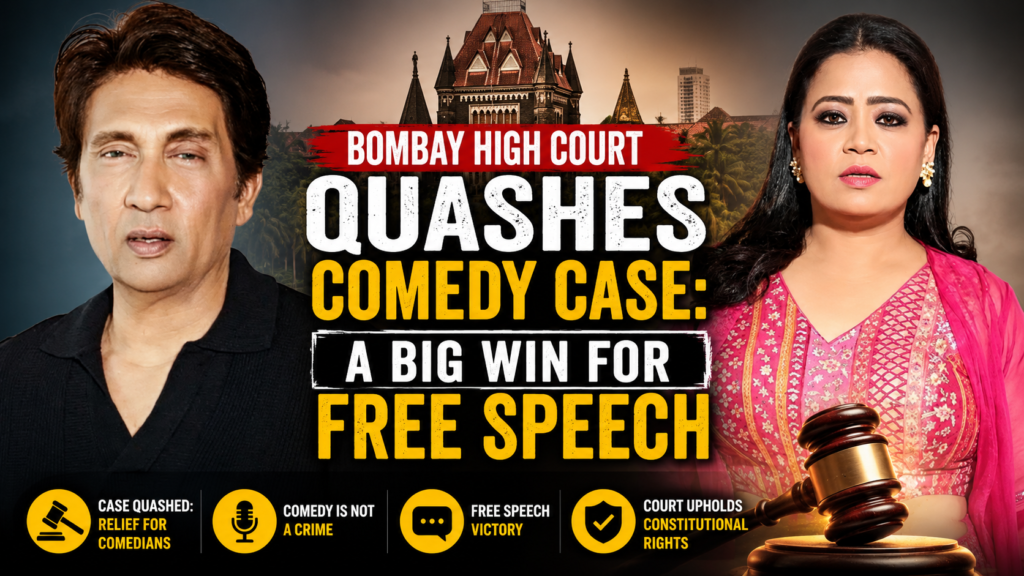
In a landmark decision, the Bombay High Court has finally put an end to a 16-year-old legal battle involving comedians and a television show. The case, which dates back to 2010, revolved around alleged remarks made during a comedy performance that were claimed to hurt religious sentiments.
With this ruling, the court has not only granted relief to Bharti Singh and Shekhar Suman, but also reinforced a critical principle:
Comedy must be viewed in context—not dissected for offense.
This blog explores:
- What the case was about
- Why the court dismissed it
- Legal insights on Section 295-A IPC
- Impact on comedians and content creators
- What this means for freedom of expression in India
Understanding the Keyword: Bombay High Court Comedy Case Verdict
The primary keyword “Bombay High Court comedy case verdict” reflects a broader issue:
Where do we draw the line between humor and offense?
Background: What Triggered the Controversy?
The controversy began with an episode of the TV show:
- Comedy Circus Ka Jadoo
- Aired in November 2010
What Happened?
During a comedic act:
- Certain phrases like “Ya Allah! Rasgulla! Dahi Bhalla” were used
- A complaint alleged religious insensitivity
The complaint was filed by:
- A representative of Raza Academy
Who Were Named in the FIR?
- Bharti Singh
- Shekhar Suman
- Television channel
- Scriptwriter
Why Did the Case Last 16 Years?
This isn’t unusual in India’s legal system.
Common Reasons:
- Judicial backlog
- Procedural delays
- Lack of early dismissal mechanisms
Result: Even weak cases can linger for years.
The Verdict: What Did the Court Say?
Justice Amit Borkar delivered a decisive judgment.
Key Observations:
- The show was meant for “light entertainment”
- Words used in a comic setting do not automatically insult religion
- The complaint lacked direct verification
- No evidence of deliberate or malicious intent
Section 295-A IPC Explained
What Does It Say?
Section 295-A deals with:
Deliberate and malicious acts intended to outrage religious feelings
Court’s Clarification:
To establish an offence:
- There must be clear intent
- The act must be deliberate and malicious
Absent intent = No crime
Did You Know?
Many cases under Section 295-A fail because proving “intent” is extremely difficult.
Why Context Matters in Comedy
The court made a crucial point:
Comedy cannot be judged like political or religious speech.
Key Takeaways on Interpretation:
- Content must be viewed as a whole
- Not based on isolated lines
- Humor often uses exaggeration and absurdity
Comedy vs Legal Interpretation
| Aspect | Comedy | Legal View |
|---|---|---|
| Purpose | Entertainment | Intent scrutiny |
| Language | Exaggerated | Literal |
| Context | Flexible | Critical |
| Risk | Misinterpretation | Legal action |
The Problem with Selective Outrage
What Went Wrong in This Case?
- Complaint filed without personally watching the show
- Based on second-hand information
- No preliminary verification
Why This Is Dangerous:
- Encourages misuse of legal provisions
- Harms creative freedom
- Wastes judicial resources
Real-World Impact on Content Creators
This verdict sends a strong message to:
Comedians
- You have legal backing if intent is not malicious
Content Creators
- Context matters more than isolated expressions
Influencers
- Responsible humor is still essential
Reaction from the Artists
Shekhar Suman expressed surprise:
- He was unaware of ongoing proceedings
- Called the case unnecessary
- Thanked the judiciary for justice
His response highlights how long-pending cases can affect individuals unknowingly
Free Speech vs Religious Sensitivity
This case sits at the intersection of two critical rights:
1. Freedom of Expression
- Protected under Article 19(1)(a)
2. Religious Sensitivity
- Protected under legal provisions like Section 295-A
The Balance:
| Freedom | Responsibility |
|---|---|
| Speak freely | Avoid deliberate harm |
| Create content | Respect diversity |
What This Means for India’s Entertainment Industry
Positive Outcomes:
- Encourages creative expression
- Reduces fear of legal harassment
- Sets precedent for similar cases
Remaining Challenges:
- Misuse of legal provisions
- Social media outrage culture
- Lack of awareness about laws
Pro Tip: How Creators Can Stay Legally Safe
- Avoid targeting specific communities
- Ensure humor is contextual and non-malicious
- Keep records of scripts and intent
- Understand basic legal boundaries
Common Myths About Comedy & Law
Myth 1: “Any offensive joke is illegal”
Reality: Only intentional harm is punishable.
Myth 2: “Anyone can file a complaint”
Reality: Complaints need credible basis and verification.
Myth 3: “Old cases don’t matter”
Reality: They can resurface anytime.
Key Takeaways
- Bombay High Court dismissed a 16-year-old comedy-related FIR
- No evidence of malicious intent found
- Reinforces importance of context in comedy
- Highlights misuse of Section 295-A IPC
- Strengthens freedom of expression in India
FAQs (SEO Optimized)
1. What was the Bombay High Court comedy case about?
It involved alleged offensive remarks made during a comedy show in 2010.
2. Why did the court dismiss the case?
Due to lack of malicious intent and credible evidence.
3. What is Section 295-A IPC?
A law dealing with intentional acts that hurt religious sentiments.
4. Can comedians be legally prosecuted for jokes?
Only if there is clear and deliberate intent to offend.
5. What does this verdict mean for free speech?
It strengthens protections for creative and comedic expression.
Conclusion: A Win for Common Sense and Creativity
This ruling by the Bombay High Court is more than just legal closure—it’s a powerful statement.
Context matters. Intent matters. Freedom matters.
For comedians, creators, and audiences alike, this case is a reminder that humor should be understood—not weaponized.
Final CTA
What do you think—should comedy have limits, or should creative freedom come first?
About the Author