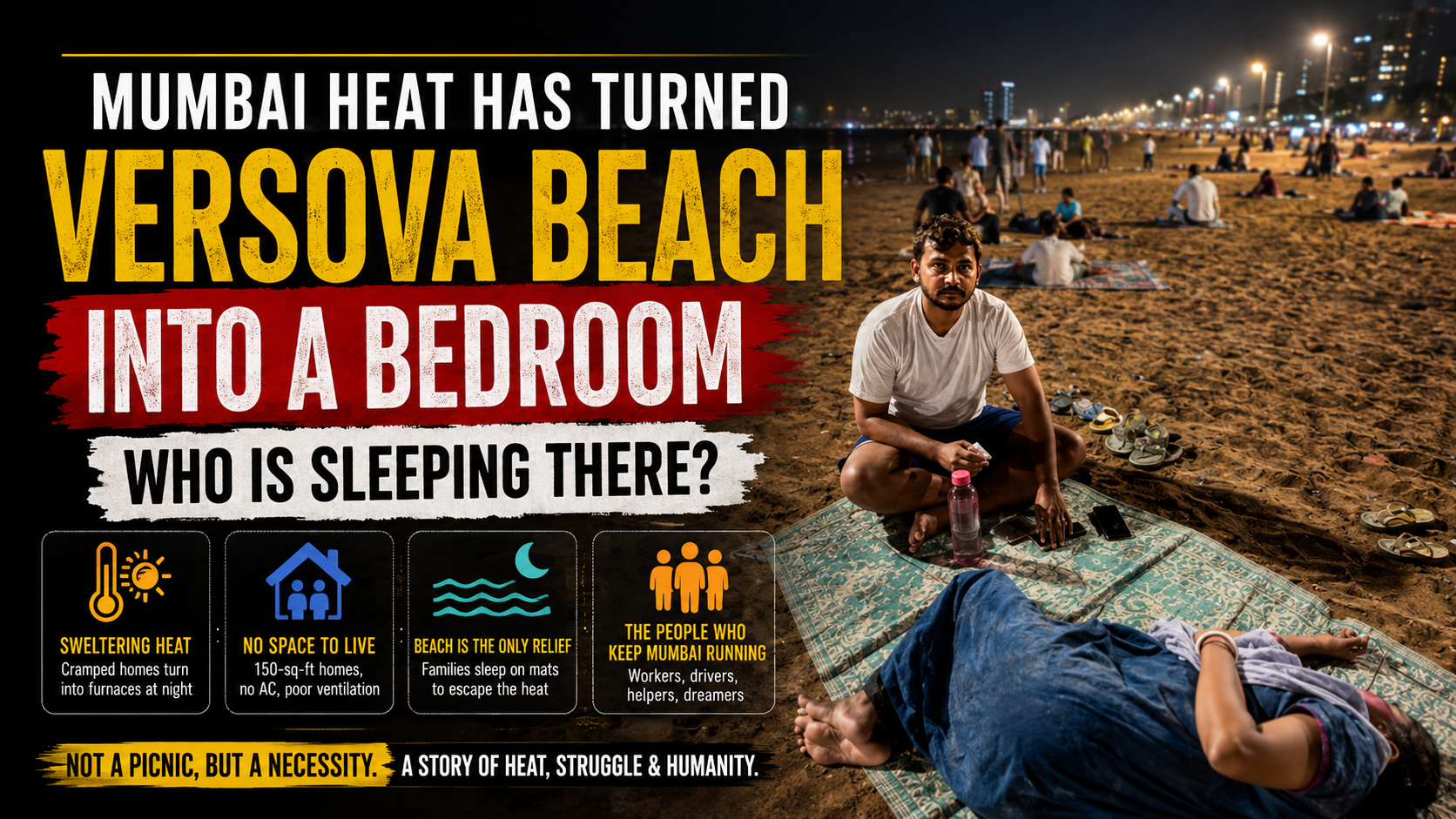
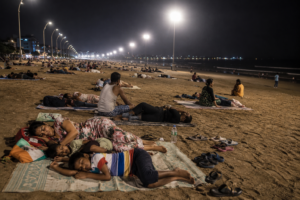
As Mumbai battles intense humidity and delayed monsoon rains, an unusual scene has become increasingly common at Versova beach. Long after sunset, families carrying mats, bedsheets, and thin blankets walk towards the shore—not for a midnight picnic, but for a few hours of relief from the suffocating heat trapped inside their tiny homes.
What began as a survival strategy for residents of nearby Sagar Kutir has now sparked heated debates on social media, with some affluent residents complaining about “encroachment” and “outsiders” taking over public spaces. But behind the controversy lies a much larger story about climate, inequality, migration, and the everyday struggles of Mumbai’s working class.
Why Are People Sleeping on Versova Beach?
By around 11 pm, after dinner is over and household chores are done, families from Sagar Kutir—a government-notified slum near Versova—head towards the beach carrying floor mats and bedsheets.
For many, the beach offers something their homes cannot: air.
With temperatures remaining high even after sunset and humidity levels soaring, cramped homes with tin roofs and poor ventilation become unbearable. The sea breeze at Versova beach provides the only escape from the relentless heat.
Auto-rickshaw driver Sadashiv Patil explains:
“People think we are coming to the beach for enjoyment. This is not a picnic. This is the only way we get some air. The heat does not leave even at night. We keep sweating till morning.”
His concern is not only for himself but also for his school-going children, who struggle to sleep inside their overcrowded home.
Tiny Homes Turn Into Furnaces
Most families in Sagar Kutir live in houses measuring around 150 square feet. Entire families share these cramped spaces with limited windows, poor ventilation, and no air conditioning.
Even basic cooling facilities like exhaust fans are absent in many homes.
Surekha Bacche, who works as a domestic helper in Seven Bungalows, spends her day cleaning air-conditioned apartments before returning to a house where sleeping becomes nearly impossible.
“We come to the beach because here we can sleep without sweating constantly,” she says.
The contrast between the lives of Mumbai’s wealthy and its working class is impossible to ignore. While some residents enjoy multiple air conditioners, others rely on the sea breeze to survive.
Social Media Backlash Sparks Class Debate
Images of families sleeping on Versova beach recently went viral, triggering a storm on social media.
Some users complained that the beach was becoming overcrowded and accused migrants of “encroaching” on public spaces. Certain posts even referred to the phenomenon as the “Biharification” of Mumbai.
One viral post declared:
“If you don’t have space to live, then please leave Mumbai.”
Others tagged government officials and demanded action against those sleeping on the beach.
These comments have reignited long-standing debates around migration and who has the right to occupy public spaces in India’s financial capital.
The People Sleeping There Help Run Mumbai
Ironically, many of the people being criticized are essential workers who keep Mumbai functioning every day.
Among them are:
- Auto-rickshaw drivers
- Domestic workers
- Delivery personnel
- Dabbawalas
- Security guards
- Daily wage labourers
These are the people who deliver lunches, clean homes, transport commuters, and perform countless tasks that support the city’s economy.
Many residents point out that while they may live in slums, they are also taxpayers and contributors to Mumbai’s growth.
Delayed Monsoon and Rising Temperatures Worsen Conditions
This year, Maharashtra has experienced prolonged pre-monsoon heat due to weak monsoon winds and the impact of El Niño, a weather pattern associated with warming Pacific Ocean waters.
Meteorologists say the delayed arrival of rains has intensified humidity levels across Mumbai.
Unlike daytime heat, nighttime temperatures have remained high, preventing homes from cooling down after sunset.
Experts note that poorly ventilated structures retain heat long after sunset, turning small rooms into ovens.
As a result, thousands of residents seek cooler outdoor spaces to sleep.
Loss of Mangroves Adds to the Problem
Twenty-six-year-old martial arts trainer Babloo Mandel believes environmental changes have worsened conditions around Versova.
According to him, mangroves near the coast were cleared to make way for the northern extension of the Coastal Road project connecting Versova and Bhayander.
He says:
“These trees provided cooling and shelter for us. They also prevented flooding and protected our homes. Now all we are left with is humidity and sweat.”
Mandel’s family has lived in Mumbai since the late 1980s after migrating from Bihar.
His father, an auto-rickshaw driver, works long hours and simply needs a few peaceful hours of sleep each night.
Migration Debate Resurfaces
The controversy has also reopened discussions around migration in Mumbai.
Many families currently living in Sagar Kutir migrated decades ago from Bihar, Uttar Pradesh, and other parts of India.
Their children were born and raised in Mumbai and consider themselves Mumbaikars.
For Babloo Mandel, criticism directed at migrants feels unfair.
“I was born in Mumbai,” he says.
His story reflects the reality of thousands of families who have spent generations contributing to the city’s growth while continuing to struggle for basic living conditions.
Public Spaces and the Right to Relief
Urban experts argue that beaches, parks, and public spaces belong to everyone—not just the affluent.
As climate change intensifies heat waves and urban temperatures continue to rise, cities may need to rethink how public spaces can provide relief to vulnerable communities.
The sight of families sleeping on Versova beach highlights deeper problems:
- Housing shortages
- Overcrowded slums
- Lack of affordable housing
- Climate change
- Urban inequality
These are issues that cannot be solved simply by asking people to leave.
Climate Change Is Making Heat More Dangerous
Scientists warn that extreme heat events are becoming more frequent across India.
Cities like Delhi and Mumbai are increasingly experiencing:
- Hotter nights
- Increased humidity
- Delayed monsoons
- Heatwaves lasting longer
Poor communities are often the most vulnerable because they lack access to cooling systems and adequate housing.
Without intervention, such scenes may become more common in the years ahead.
A Tale of Two Mumbais
The image of families sleeping on Versova beach reveals the stark inequalities that coexist within Mumbai.
On one side are high-rise apartments with air conditioners running throughout the night.
On the other are workers carrying bedsheets to the beach simply to escape the heat.
For many residents of Sagar Kutir, Versova beach isn’t a place of leisure.
It’s a bedroom.
It’s where exhausted auto drivers, domestic workers, and children find temporary comfort beneath the open sky.
And perhaps more importantly, it serves as a reminder that climate change and housing inequality are no longer distant problems—they are realities that thousands of Mumbaikars confront every night.
This website is proudly managed and maintained by Shunya Digit.