
Bleach Lore Explained: Soul Society, Hollows, Quincies and the Anime’s Biggest Mysteries

Bleach Lore Explained: Soul Society, Hollows, Quincies and the Anime’s Biggest Mysteries
Few anime worlds are as stylishly complicated as Bleach. Beneath the sword fights, dramatic entrances and impossibly cool character designs lies a cosmic system built on souls, reincarnation, political control and one very fragile balance between worlds. With the autumn 2026 conversation focused on the anime’s final Thousand-Year Blood War revelations, there is no better time to revisit the lore that made Ichigo Kurosaki’s journey so fascinating.
Bleach’s Afterlife Explained: How the World of the Living, Soul Society and Other Realms Connect
The basic structure of Bleach begins with three connected spaces: the World of the Living, Soul Society and Hueco Mundo. The World of the Living is modern-day Japan, where humans live ordinary lives without seeing most spiritual beings. Soul Society is the afterlife, a vast realm where human souls are sent after death and where the Soul Reapers maintain order. Hueco Mundo is the bleak desert realm associated with Hollows and Arrancar.
When a human dies, their soul becomes a Plus. A Soul Reaper can perform a Konso, or soul burial, sending that spirit to Soul Society. If the soul is consumed by regret, fear or obsession, however, it may transform into a Hollow. This is where the series’ central danger begins: a damaged soul can become a predator that threatens both humans and the spiritual balance.
Soul Reapers are not simply ghostly warriors. They are guardians, exorcists and enforcers of the cycle linking life and death. They destroy Hollows, guide human souls and prevent spiritual pressure from becoming dangerously uneven between realms. If too many souls gather in one world, the borders separating reality can weaken and collapse.
Other dimensions also matter. Garganta allows Hollows and Arrancar to travel through a dark space between realms, while the Dangai functions as a dangerous passage connecting the World of the Living and Soul Society. Above Soul Society sits the Royal Palace, home of the Soul King and the elite Royal Guard. Together, these places create a cosmology that feels less like a simple heaven-and-hell setup and more like a carefully managed supernatural ecosystem.
Soul Society’s Power Structure and Hidden History
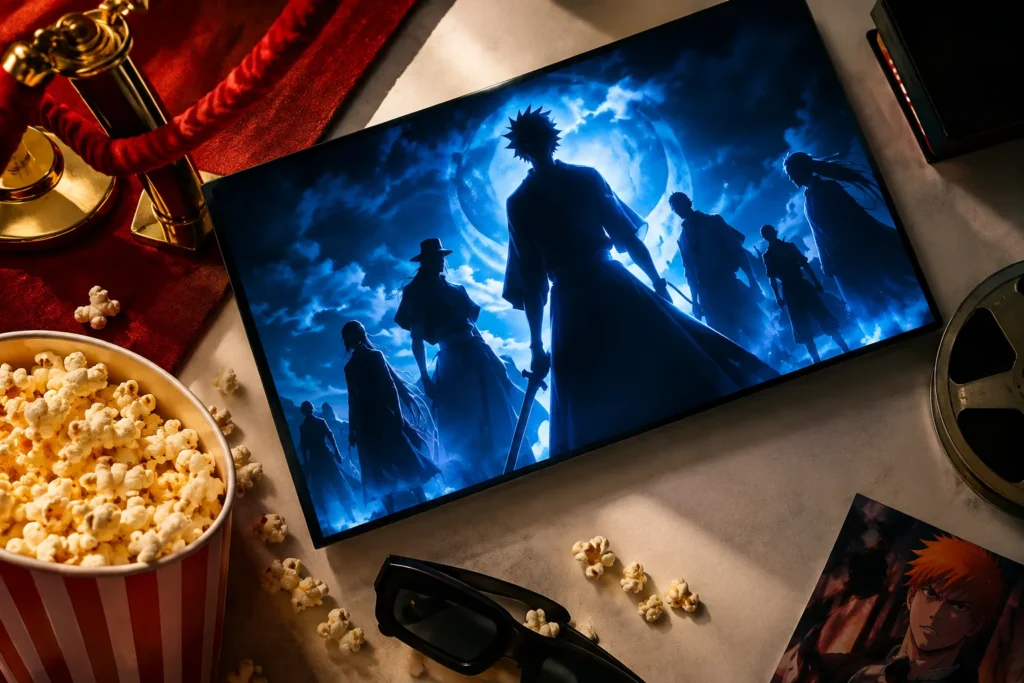
Soul Society may look peaceful from the outside, but its government is built on layers of military authority, aristocratic privilege and deeply guarded secrets. The most visible institution is the Gotei 13, the thirteen-division military organisation led by the Captain-Commander. Each division has its own captain and lieutenant, although the personalities and methods inside those divisions can be dramatically different.
Above the Gotei 13 sits Central 46, a council that creates laws, authorises punishment and makes major political decisions. Its authority is officially legal, but Bleach repeatedly questions whether law is the same thing as justice. The council’s decisions often protect the institution first, especially when truth could threaten Soul Society’s legitimacy.
Noble clans add another layer to the hierarchy. Families such as the Kuchiki and Shihōin clans possess history, influence and traditions that ordinary Soul Reapers cannot easily challenge. Their status helps explain why characters such as Byakuya Kuchiki carry so much political weight, even when personal feelings pull them in another direction.
The greatest secret sits in the Royal Palace. The Soul King is presented as the ruler of the spiritual realms, yet the truth of his position is far more disturbing. The original order of the worlds was not created through a clean, heroic act. It was shaped by fear, sacrifice and a decision made by powerful beings who believed stability mattered more than freedom.
That hidden history changes the meaning of Soul Society’s laws. The system survives, but it is not morally perfect. Its traditions are often treated as sacred because questioning them could expose the foundations of the entire universe. This is one reason Bleach works so well as fantasy: the heroes are not just fighting monsters. They are gradually discovering that the institutions protecting reality may also be responsible for its deepest wounds.
Hollows, Arrancar and the Meaning of “Heart” in Bleach
A Hollow is a human soul that has lost its heart, identity or connection to ordinary existence. The hole in a Hollow’s body symbolises that absence, while its mask represents both its monstrous transformation and the emotions it can no longer process normally. Hollows are dangerous, but the series rarely treats them as simple villains.
Some Hollows evolve by devouring other Hollows. The first major stage is the Menos, a term covering several increasingly powerful forms. Gillian are enormous and generally uniform in appearance. Adjuchas are more individual and intelligent, while Vasto Lorde are extremely rare and possess power that can rival the strongest Soul Reapers.
Arrancar are Hollows who remove or break their masks and gain Soul Reaper-like abilities. Their transformation gives them humanoid bodies, Zanpakutō and access to powers such as Resurrección. The result is a being caught between categories: no longer a normal Hollow, but not a Soul Reaper either.
The symbolism of the mask is central to the lore. It shows how identity can become both protection and prison. Characters such as Ichigo’s Visored allies demonstrate that Hollow power does not automatically erase a person’s humanity. Meanwhile, the Arrancar reveal that intelligence, love, loyalty and grief can survive inside creatures created by spiritual corruption.
That is why the word “heart” appears so often in Bleach. It does not refer only to kindness. It means the emotional core that connects one soul to another. Even characters who behave like monsters may still be driven by loneliness, devotion or the need to be remembered. The series’ most affecting Hollow stories work because they ask whether a lost soul can still choose what kind of being it wants to become.
Quincies, Yhwach and the Conflict Over the Soul Cycle
Quincies are spiritually aware humans who fight Hollows by gathering and shaping surrounding reishi. Unlike Soul Reapers, who purify Hollows and return their souls to the cycle, Quincies erase Hollows completely. That difference created the historic conflict between the two groups.
From the Quincy perspective, Hollows are deadly monsters that must be destroyed before they harm innocent people. From the Soul Reaper perspective, Quincy extermination destabilises the balance between the worlds. Neither side is entirely without reason, but centuries of mistrust turned a philosophical disagreement into open war.
Quincy techniques include the creation of spirit weapons, reishi manipulation and defensive abilities such as Blut. Blut Vene reinforces the body, while Blut Arterie increases offensive strength. Their elite warriors, the Sternritter, receive individual powers known as Schrift, each represented by a letter and connected to a distinctive ability.
At the centre of the Quincy campaign stands Yhwach, the progenitor of the Quincy bloodline and the son of the Soul King. His power, The Almighty, allows him to perceive and alter possible futures. This makes him more than a conventional conqueror. Yhwach believes the current cycle of life, death and fear is fundamentally cruel, and he wants to replace it with a world where death no longer has the same meaning.
His vision sounds liberating until its consequences become clear. A universe without the boundaries between life and death may also be a universe without individuality, uncertainty or the chance to change. The Thousand-Year Blood War is therefore a clash of armies, but also a debate over whether an imperfect world is preferable to a controlled paradise.
The Soul King, Ichigo’s Heritage and Bleach’s Biggest Unanswered Mysteries

Ichigo’s unusual strength is not an accident. He is connected to multiple spiritual lineages: human, Soul Reaper, Hollow and Quincy. His mother, Masaki Kurosaki, was a Quincy, while his father, Isshin Shiba, was a former Soul Reaper captain. Ichigo’s Hollow powers were also tied to the circumstances surrounding his birth and the experiments that affected Masaki’s life.
This mixed heritage explains why Ichigo can use different forms of power without fitting neatly into one faction. His Zanpakutō, Zangetsu, is not merely a weapon handed to him by tradition. It reflects the complicated combination of forces inside him, including his Quincy inheritance and his inner Hollow nature.
The Soul King’s role makes Ichigo’s story even more significant. The Soul King is a stabilising lynchpin whose existence allows the realms to remain separate. Yet the revelation that he was reduced to this function turns the supposed foundation of the universe into a moral question. Is preserving balance still righteous when the system depends on the suffering of one being?
Several mysteries remain especially important. The original sin of Soul Society’s founders is only partly explained, and the full history of the first division of the worlds continues to invite interpretation. Hell is another major question, especially after the series hints that powerful souls do not simply disappear after death. The relationship between Hell, Soul Society and the fate of dead captains remains one of the most intriguing loose threads.
As of November 8, 2026, anime viewers should also separate confirmed revelations from fan theories. The anime has established Ichigo’s heritage, Yhwach’s connection to the Soul King and the political darkness behind the world’s structure. Ideas about future Hell arcs, hidden royal figures or the ultimate fate of the soul cycle remain speculation unless the adaptation confirms them directly.
Bleach Lore Watch Guide: What to Remember Before the Anime’s Final Revelations
For newcomers, the easiest way into the mythology is to follow Ichigo’s journey in order rather than trying to memorise every division and technique immediately. Start with the Substitute Soul Reaper and Soul Society arcs, then continue through the Arrancar conflict and the Fullbring storyline before reaching the Thousand-Year Blood War.
Before watching the current autumn 2026 anime season, keep four ideas in mind: Soul Reapers preserve the cycle, Hollows represent souls that have lost their connection, Quincies erase Hollows instead of purifying them, and the Soul King’s system is far more morally complicated than early episodes suggest.
It is also worth remembering that every faction has a point of view. The Gotei 13 protects ordinary people but hides uncomfortable history. Hollows can be terrifying while still retaining fragments of emotion. Quincies oppose the Soul Reapers for understandable reasons, even when their methods become extreme. Ichigo’s role is powerful precisely because he can see the value and danger in all these worlds.
Where can you watch? Availability varies by country, but Bleach and Bleach: Thousand-Year Blood War have been distributed through major anime streaming services, including Hulu in the United States and Disney+ in many international markets. Check your local catalogue for the most accurate autumn 2026 availability, as episode rights can differ by region.
For a broader plot refresher before revisiting the lore, read our Bleach anime summary covering Ichigo’s journey to the Thousand-Year Blood War. It is a useful companion for remembering the major battles without spoiling every late-series surprise.
Ready to return to Soul Society and follow the final mysteries as they unfold?
Verdict: Bleach remains one of anime’s richest supernatural universes because its lore is never only about power levels. It is about identity, inherited history, political control and the dangerous question of whether balance is worth preserving at any cost. With the final anime revelations still driving fan discussions in autumn 2026, its biggest mysteries remain as compelling as its battles.